KJC Medicinal Garden
Sampige
Magnolia champaca
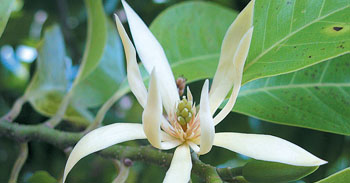
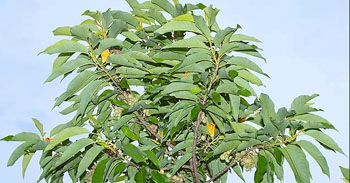
Order: Magnoliales
Family: Magnolia
Genus: Michelia
Species: M. champaca
Common Names: Champaca, Champak
Native to India, Java, Philippines
Other plants of the same genus with medicinal properties
-
M. angustioblonga
M. balansae
M. bailloni
M. braianensis
M. caloptila
M. cavaleriei
- Tree up to 50 m or taller, up to1.9 m d.b.h
- Flowers are fragrant, tepals 15-20, yellow, inverted-lance shaped, 2-4 x 0.4-0.5 cm
- P. Buds, young twigs, young petioles, and young leaf blades are pale yellow velvet-hairy
- Twigs are ascending and forming a narrow umbelliform crow
Uses in Tradition systems of medicine
- Used in Ayurveda and Siddha
- Used in fever, colic, leprosy, post-partum protection and in eye disorders
- Juice of the leaves of Michelia champaca is given with honey in cases of colic
- The flower oil is useful in cephalalgia, opthalmia and gout
- The bark is used as a stimulant, expectorant, astringent and febrifugal properties.
- Liriodenine, macheline, lanuginosine
- Minerals- Glucose, Magnesium sulphate, Calcium chloride
- Essential oils from flowers: - champacene, linalool
Suggested Medicinal Properties
- Diarrhea
- Cough
- Bronchitis
- Hypertension
- Dyspepsia
- Fever
- Rheumatism
- Abscesses
- Dysmenorrhea
- Inflammation
- Astringent
- Purgative
- Stomachic
Active Phytochemicals
1. Sophoracoumestan (3-Hydroxy-4-methoxy-8,9-methylenedioxycoumestan)
2. α-humulene [(1E,4E,8E)-2,6,6,9- tetramethylcycloundeca-1,4,8- triene]
3. Parthenolide [(E,1aR,7aS,10aS,10bS)- 2,3,6,7,7a,8-hexahydro-1a,5- dimethyl-8-methylene-11-oxabicyclo [8.1.0] undeca-1(10),4- dieno [9,8-b] furan9(1aH,10aH,10bH)-one]
4. Geraniol (E)-3,7-dimethylocta-2,6-dien-1- ol
5. Guaianolide decahydro-3,5,8- trimethylazuleno[6,5-b]furan2(3H)-one
6. Iso-eugenol 2-methoxy-4-((E)-prop-1- enyl) phenol
7. Liriodenine 8H-Benzo[G]-1,3- benzodioxolo[6,5,4-de]quinolin8-one;Noraporphin-7-one, 4,5,6,6A-tetradehydro-1,2- (methylenedioxy)
8. Methyl anthranilate methyl 2-aminobenzoate
9. Methyl linoleate (9Z,12Z)-methyl octadeca-9,12- dienoate
10. Quercetin 3,5,7-trihydroxy-2-(3,4- dihydroxyphenyl) chroman-4-one
11. Shikimic acid (3R,4S,5R)-3,4,5- trihydroxycyclohex-1- enecarboxylic acid
12. Stigmasterol (3S,8R,9S,10R,13R,14S,17R)- 2,3,4,7,8,9,10,11,12,13,14,15,16,1 7-tetradecahydro-17-((E,2R,5S)- 5-isopropylhept-3-en-2-yl)- 10,13,14-trimethyl-1Hcyclopenta[a]phenanthren-3-ol
References
Rout, P. K., Naik, S. N., & Rao, Y. R. (2006). Composition of the concrete, absolute, headspace and essential oil of the flowers of Michelia champaca Linn. Flavour and Fragrance Journal, 21(6), 906-911
Ibrahim, R., Salahbiah, A. M., Khoo, C. K., Azhar, M., Ashanul, K. A. W., Rasol, A., & Muse, R. (2005). Development of embryogenic culture system for the production of essential oils using bioreactor technology from Michelia alba. P-INCOBB18
Hoffmann, J. J., Torrance, S. J., Wiedhopf, R. M., & Cole, J. R. (1977). Cytotoxic agents from Michelia champaca and Talauma ovata: parthenolide and costunolide. Journal of Pharmaceutical Sciences, 66(6), 883-884