Orientation Session
Orientation programme on Alternative Dispute Resolution (ADR)
Date: 25 August 2026
The Centre for Alternative Dispute Resolution (ADR) Cell, Kristu Jayanti, School of Law conducted an orientation programme on Alternative Dispute Resolution (ADR) exclusively for first-year law students on 25 August 2026 at 12:40 p.m. The session was conducted by the Core Committee members of the ADR Cell, with a primary focus on introducing students to ADR from a competition-oriented perspective.
The programme familiarised students with the practical aspects of ADR competitions and the roles they are expected to undertake in different competition formats. A practical problem-solving activity was incorporated into the session, enabling students to actively participate, analyse the given problem, and understand their respective roles. The interactive approach helped students gain a basic understanding of ADR processes while encouraging them to explore and participate in ADR competitions.
Overall, the orientation served as a practical introduction to ADR and motivated first-year students to develop their skills and actively engage in the activities and competitions organised by the ADR Cell.

Orientation Program on Moot Court Practice for Second -Year Students
Date: 07 August 2026
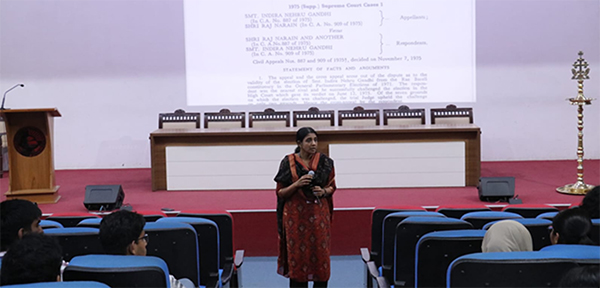
The Moot Court Orientation Program was conducted for the first-year students to introduce them to the fundamentals of moot court practice and to prepare them for the upcoming intra-moot competition. The session was designed to combine a theoretical understanding of case law with a practical, hands-on discussion of the moot proposition.
Moot Court Orientation Programme
Date: 03 August 2026
The Mooters’ Society, School of Law, Kristu Jayanti (Deemed to be University), organised a Moot Court Orientation Programme for first-year law students to introduce them to the fundamentals of moot court practice and prepare them for the intra-moot competition. The landmark judgment of Vishaka v. State of Rajasthan was discussed to familiarise students with systematic case reading, including facts, issues, arguments, precedents, and ratio decidendi. The intra-moot proposition was also discussed in detail, with guidance on identifying legal issues, conducting preliminary research, and structuring arguments for both sides. The programme provided students with essential foundational skills for effective moot court participation.

Placement Orientation and Training Programme (POTP) Session
Date: 24 July 2026
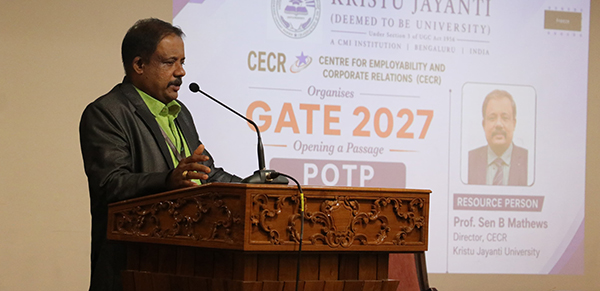
The School of Law in collaboration with The Centre for Employability and Corporate Relations (CECR), Kristu Jayanti (Deemed to be University) have organised the Placement Orientation and Training Programme (POTP) Session for Law students on 24.07.2026.
The session helped the students to familiarise the University's placement process, expectations from students, professional etiquette, eligibility requirements, training initiatives, and the standards expected during internships and campus recruitment
Orientation programme on “Decoding Legal Citation: An Orientation”
Date: 10 April 2026
The School of Law in collaboration with Library Resource Usage Optimization Committee organized an orientation programme titled “Decoding Legal Citation: An Orientation” on 10th April 2026. The session was conducted by Dr. Vanshika Kumar, who served as the resource person. The programme focused on simplifying the complexities of legal citation and provided students with a structured approach to understanding various citation styles used in legal writing. Dr. Kumar explained the importance of precise referencing in legal research, emphasizing how proper citation enhances the credibility and authenticity of legal documents.

Orientation Session on Trial Advocacy
Date: 25 February 2026
The School of Law, Kristu Jayanti (Deemed to be University) conducted an Orientation Session on Trial Advocacy on 25.02.2026 for the students of the 2nd and 4th semester BA LL.B, BBA LL.B, and B.Com LL.B programmes. The session was organised with the objective of familiarising students with the fundamentals of courtroom advocacy and introducing them to the practical dimensions of trial practice.
The session was delivered by Ujwala P., Assistant Professor, School of Law, CHRIST (Deemed to be University), Bengaluru, who brought with her rich academic and experiential insights in the field of trial advocacy. She briefed the students on the basic principles and rules governing courtroom advocacy, emphasising its relevance in shaping competent and ethical legal professionals.
During the session, Prof. Ujwala highlighted the importance of trial advocacy in building confidence among law students and in developing essential skills such as effective listening, structured drafting, logical reasoning, and persuasive communication skills that are vital for any aspiring lawyer. She also explained the technicalities of trial advocacy competitions, including their structure, format, and conduct, providing students with a clear understanding of practical advocacy platforms.
The orientation proved to be highly informative and engaging, equipping students with foundational knowledge, and motivating them to actively participate in advocacy-based learning and competitions in the future.

Orientation Session on Negotiation
Date: 28 January 2026
The session on Negotiation was conducted by Prof. Jennifer Stevenson, Willamette University, Salem, Oregon who introduced negotiation as a structured and strategic process aimed at reaching mutually acceptable outcomes rather than a mere exercise of power or persuasion. Ma’am explained that negotiation is a part of everyday decision-making and becomes particularly significant in legal, professional, and interpersonal contexts. Emphasis was placed on understanding the difference between positional bargaining and interest-based negotiation. Positional bargaining, where parties rigidly adhere to fixed demands, was highlighted as inefficient and relationship-damaging. Professor Jennifer cautioned against extreme positions, noting that they often lead to deadlocks and make compromise difficult. The session also discussed soft and hard negotiation styles, pointing out that while soft negotiation may risk excessive compromise and hard negotiation may strain relationships, neither approach is universally effective and must be chosen carefully depending on the situation.
She further focused on principled negotiation as a more balanced and effective alternative. This approach was explained through its core elements: separating people from the problem, focusing on interests rather than positions, generating multiple options, and relying on objective criteria. The concept of BATNA (Best Alternative to a Negotiated Agreement) was also discussed as a crucial tool to assess bargaining power and avoid unfavourable agreements. Prof. highlighted the criteria for successful negotiation, stating that all negotiations should aim to produce a wise agreement, be efficient, and maintain or improve relationships between the parties. The session concluded with a clear emphasis on ethical negotiation, warning against manipulation and coercive tactics, and encouraging participants to negotiate with clarity, flexibility, and long-term perspective.