PO, PSO
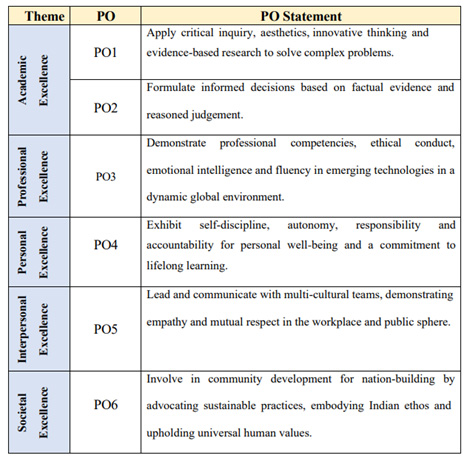
Programme Outcomes for the UG course:
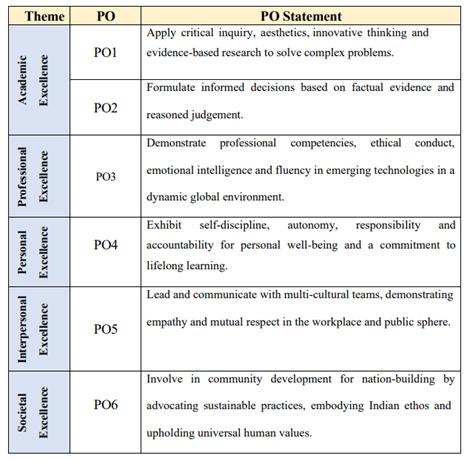
Programme Outcomes for the PG courses:
Programme Specific Outcomes (PSO)
BSc Psychology
After the successful completion of the programme students will be able to:
- PO1: Demonstrate knowledge of clinical, industrial and counselling Psychology.
- PO2: Exhibit proficiency in assessment and reporting of psychological testing in social settings.
- PO3: Develop interventions and techniques using evidence based psychological practices adhering to ethical and scientific norms.
- PO4: Formulate solutions and strategies based on systematic research in Psychology.
Programme Specific Outcomes (PSO) for the PG Course
2025–2027 MSc Psychology
After the successful completion of the programme, students will be able to:
- PSO1: demonstrate knowledge of core and contemporary psychological theories of personality, cognitive neuroscience, neuropsychological testing, psychological test construction, statistics and organizational behavior.
- PSO2: Exhibit proficiency in conventional and computer based psychological assessments for diagnosis and therapeutic interventions adhering to professional ethics.
- PSO3: Develop therapeutic interventions through evidence-based practices in industrial and clinical settings.
- PSO4: Formulate solutions and strategies based on systematic research in Psychology.
2025–2027 MSc Counselling Psychology
After the successful completion of the programme, students will be able to:
- PSO1: demonstrate knowledge of foundational and contemporary frameworks of lifespan development, family interventions, workplace counselling, child and adolescent counselling.
- PSO2: apply counselling therapeutic practices adhering to ethical professional conduct.
- PSO3: Develop therapeutic interventions through evidence-based practices that contribute to mental health and societal well-being.
- PSO4: Formulate solutions and strategies based on systematic research in Psychology.
2025–2027 MSc Clinical Psychology
After the successful completion of the programme, students will be able to:
- PSO1: Demonstrate knowledge of psychopathology, behavioural science, neuropsychology and diagnostic classification systems to understand and conceptualize mental health disorders.
- PSO2: Apply clinical skills in assessment, diagnosis, case formulation, and psychotherapeutic intervention using evidence-based methods in social settings.
- PSO3: Develop therapeutic interventions through evidence-based practices that contribute to mental health and societal well-being.
- PSO4: Formulate solutions and strategies based on systematic research in Psychology.