Conferences
International Conference on AI Horizons 2025: Redefining Global Business Paradigms for a Sustainable Future
Date: 16 & 17 September 2025
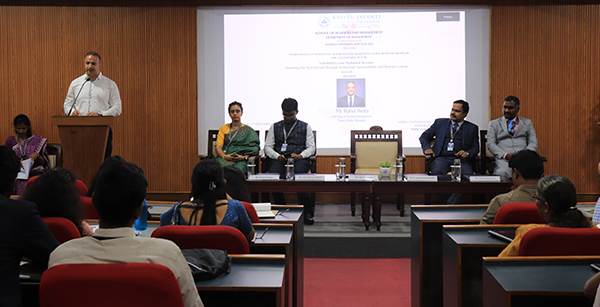
The Department of Management, Kristu Jayanti (Deemed to be University), Bengaluru, successfully hosted a Two-Day International Conference on AI Horizons 2025: Redefining Global Business Paradigms for a Sustainable Future on 16th and 17th September 2025, uniting academicians, industry leaders, innovators, and researchers to deliberate on the transformative impact of Artificial Intelligence (AI) on global business. The conference opened with an inspiring inaugural address by Mr. Clive Michael Vanuerle, Whole-time Director, OSB India, who in his session on Reimagining Leadership and Governance in the AI-Driven World emphasized the growing necessity of adaptive governance frameworks that blend AI insights with human intuition while maintaining ethics, inclusivity, and resilience. This was followed by Keynote Session I, delivered by Mr. Anil Maryala, Senior Manager, Dell Technologies, Bengaluru, who spoke on Purpose-Driven Innovation in Leading Ethical AI Start-ups for Global Impact, highlighting the crucial role of start-ups in embedding transparency, fairness, and accountability in AI innovations, thereby balancing disruption with societal benefit. Keynote Session II, by Dr. Jeffrey Stangl, Associate Dean, Massey Business School, Massey University, New Zealand, titled The Predictive Economy: AI Analytics Driving the Fintech Frontier, focused on the immense potential of AI-powered predictive analytics in reshaping financial markets, consumer behavior, risk management, and investment strategies while stressing the importance of financial inclusion and trust in digital economies.
On the second day, Dr. Senthil S, Dean, Dayananda Sagar University, Bengaluru, delivered Keynote Session III on Humans and Machines Reshaping the Future of Work and Talent in the AI Era, where he underlined the significance of lifelong learning, adaptability, and upskilling in human-machine collaborations and discussed the socio-economic implications of AI in transforming work ecosystems. This was succeeded by Keynote Session IV, in which Dr. Srinivasan, Director, Galileo Global Education, India, presented on AI-Driven Corporate Responsibility: Shaping Global Business for Tomorrow, stressing the urgent need for businesses to integrate ethical frameworks and corporate social responsibility (CSR) with AI adoption to drive sustainability, social equity, and environmental stewardship for inclusive development. The conference concluded with the valedictory session by Mr. Rahul Arora, Assistant Vice President, Times of India, Bengaluru, who envisioned a future where technological advancement is harmonized with ecological responsibility and human-centric growth, emphasizing the collaborative role of industry, academia, and media in building a sustainable AI future. The two-day deliberations produced significant outcomes by redefining leadership and governance models for the AI era, underscoring the role of purpose-driven start-ups in responsible innovation, illustrating the disruptive yet inclusive potential of predictive AI analytics in fintech, analysing the transformation of work and talent through human-machine collaboration, and advocating for the integration of AI with corporate responsibility for long-term sustainable growth. Participants gained deep insights into the multifaceted nature of AI adoption and its ethical, social, and economic dimensions, leaving them equipped with strategies to meaningfully contribute to global AI-driven transformations. The conference fostered a vibrant environment of academic rigor, cross-sectoral collaboration, and strategic foresight, reinforcing India’s preparedness to lead responsibly in the AI revolution while ensuring human values, inclusivity, and sustainability remain central. Thus, the International Conference on AI Horizons 2025 not only enriched participants’ understanding but also laid a robust foundation for building future-ready, ethically grounded, and sustainable global business paradigms in the AI-driven era.