Department of Commerce
Student Development Programme
Student Development Programme on Economic Offences
Date: 02 September 2026
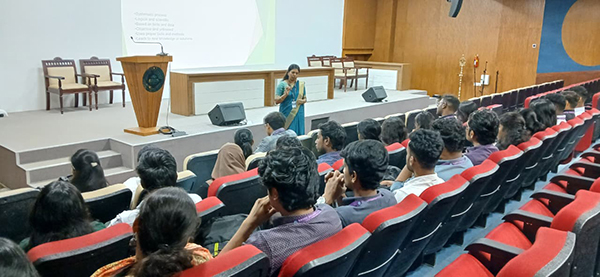
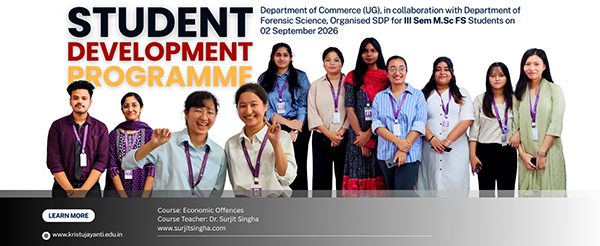
The Department of Commerce (UG), in collaboration with the Department of Forensic Science, organised a Student Development Programme (SDP) for the III Semester M.Sc. Forensic Science students on 02 September 2026. The programme was conducted as part of the course Economic Offences under the guidance of Course Teacher Dr. Surjit Singha, Associate Professor, Kristu Jayanti (Deemed to be University), Bengaluru
The programme aimed to provide students with a comprehensive understanding of the nature, forms, and implications of economic offences and to develop their analytical, communication, teamwork, and presentation skills through student-led academic presentations.
The students presented on “Introduction to Economic Offences”, covering important concepts such as economic offences, white-collar crimes, financial frauds, corruption, money laundering, corporate frauds, cyber-economic offences, and IPR-related frauds. The presentations provided an overview of how economic crimes affect individuals, businesses, financial institutions, and society.
The students further explored various typologies of economic crimes, including tax evasion, Ponzi schemes, chit funds, insider trading, hawala transactions, mule accounts, shell companies, fake invoicing, pump-and-dump schemes, influencer-led market manipulation, credit card fraud, and black money circulation. The presentations highlighted the changing nature of economic crimes in the context of digitalisation and increasingly complex financial transactions.
Another key area of discussion was the impact and implications of economic offences, particularly their effects on the economy, governance, public trust, and national security. Students also discussed the challenges faced by law enforcement agencies in detecting, investigating, and preventing sophisticated economic crimes.
The presentations were delivered by three groups. Group 1 comprised Hebsheeba Beula (25MFOR32), Prerna (25MFOR33), Zuretta (25MFOR58), Tsukholu (25MFOR64), Baniasara (25MFOR08), Madhumitha (25MFOR25), and Gurnish (25MFOR20). Group 2 comprised Eldora Mochari (25MFOR16) and Eldrina Mochari (25MFOR17). Group 3 comprised Gayatri (25MFOR19) and Nirmal Raj (25MFOR30).
The Student Development Programme provided the students with an opportunity to connect theoretical concepts with contemporary examples of economic and financial crimes. The activity also strengthened their critical thinking, collaborative learning, public speaking, and professional communication skills, which are essential for students pursuing careers in forensic science and economic crime investigation.
The programme successfully promoted interdisciplinary learning between Commerce and Forensic Science, enabling students to appreciate the financial, legal, technological, and investigative dimensions of economic offences.
SDP on Economic Offences for BSc Forensic Science Students
Date: 01 September 2026
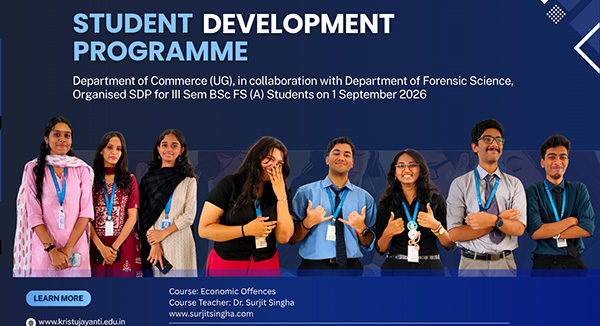
The Department of Commerce (UG), in collaboration with the Department of Forensic Science, organised a Student Development Programme (SDP) for the III Semester BSc Forensic Science (A) students on 1 September 2026 as part of the course Economic Offences. The programme was conducted under the guidance of Dr. Surjit Singha, Course Teacher, Department of Commerce (UG), Kristu Jayanti (Deemed to be University).
The programme aimed to provide students with a deeper understanding of various forms of economic offences and their implications for individuals, businesses, financial institutions, and society. It also encouraged students to explore economic offences from an interdisciplinary perspective by connecting economic concepts with forensic investigation.
As part of the programme, the students were divided into three groups and assigned different themes related to economic offences. Group 1, comprising Niranjana Vinu (25FCBA33), Vismaya A B (25FCBA59), and Vyshnavi S D (25FCBA60), presented on the concept of economic offences, fundamentals of economics in economic offences, and tax evasion.
Group 2, comprising Shelton A (25FCBA46) and Snehal B Karedan (25FCBA52), explored fraudulent bankruptcy, white-collar crime, economic exclusion, black money, corruption and bribery, money laundering, and hawala transactions.
Group 3, comprising Aishwarya Anurag Iyer (25FCBA03), Aaroush Kurup (25FCBA02), and Sharon Mary Eapen (25FCBA45), addressed tax haven countries, excise duty evasion, the theory of fraud, insurance fraud, and corporate fraud, with specific focus on financial misreporting, shell companies, and insider trading.
The students presented their topics through PowerPoint presentations and oral presentations, demonstrating their understanding of the concepts and their ability to communicate complex issues related to economic offences effectively. The activity also provided students with an opportunity to develop their research, analytical, presentation, and communication skills.
The SDP served as an engaging academic platform for students to understand the nature, mechanisms, and consequences of economic offences while appreciating the importance of interdisciplinary knowledge in the field of forensic science.
Student Development Programme on “The Research Edge: Building Future Scholars”
Date: 07 April 2026
The Department of Commerce, under the School of Commerce, Accounting and Finance, organized a Student Development Programme titled “The Research Edge: Building Future Scholars” on April 7, 2026, from 9:00 AM to 4:00 PM.
The programme aimed at strengthening the research capabilities of M. Com students by offering practical insights into various aspects of research methodology. The sessions were delivered by internal faculty members, namely Dr. Pushpa, Dr. Mohan Kumar, Dr. Vidhya S, Dr. Sakthivel, Dr. Ashwini S V and Dr. Jithesh, who covered key dimensions of research in an engaging and insightful manner.
The event experienced active student participation and functioned as a meaningful platform for developing research competencies, fostering critical thinking, and promoting academic excellence.