International Lecture Series
International Lecture Series: Adapting Traditional Plays into Computer Games
Date: 20 August 2026
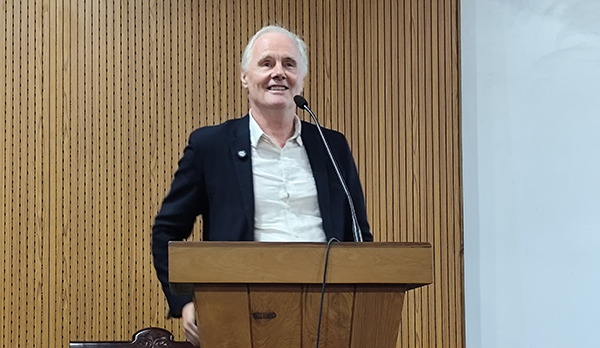
The Department of English organised a lecture as part of the International Lecture Series on 20th August 2026. The session was titled “Adapting Traditional Plays into Computer Games” and was led by Dr. Hunter Hatfield from University of Otago. The lecture focused on how interactive games are developed from the influence of traditional literary plays. The resource person talked about the play, Dover Road by A.A Milne and how he is adapting this play into an interactive form of narrative. He also talked about the different genres and the history of interactive forms of games. He talked about the significance of these interactive forms of games and how they are growing in contemporary times. He emphasised that the traditional plays still have a role to play in the contemporary times due to how they can be portrayed in the contemporary times.
Decoding Cognitive Biases
Date: 01 August 2026
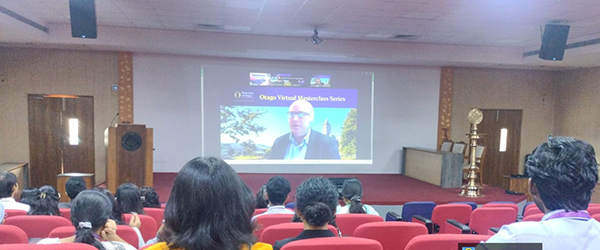
The guest lecture by Dr. Rob Jenkins, University of York, United Kingdom, offered an engaging exploration of how cognitive biases shape human thinking, judgment, and decision-making. Beginning with a series of seemingly simple questions, Dr. Jenkins demonstrated that many people confidently arrive at incorrect answers, illustrating how cognitive biases subtly influence everyday reasoning. To reinforce this idea, he conducted an interactive activity in which participants were asked to draw a bicycle. The exercise revealed that although most people are highly familiar with bicycles, only a small number could accurately represent one, highlighting the gap between perceived knowledge and actual understanding. Drawing on real-world evidence, Dr. Jenkins discussed a supermarket study in which customers were informed that they were being recorded for promotional purposes and asked for their consent. The findings revealed a striking difference between what participants believed they would do and the choices they ultimately made, underscoring the disconnect between stated intentions and actual behaviour. He also examined the concept of optimism through a comparative graph depicting optimistic, mildly depressed, and severely depressed individuals, illustrating how different psychological states shape perceptions of reality. Concluding the session, Dr. Jenkins emphasized that despite humanity's confidence in its intellectual abilities, our judgments are often constrained by cognitive biases, encouraging the audience to reflect critically on the limitations of human reasoning and the importance of greater self-awareness in decision-making.
International Research Consultation Forum
Date: 22 June 2026
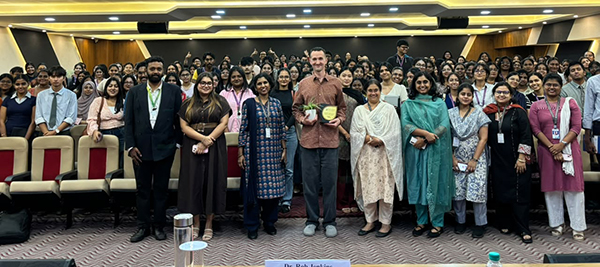
The Department of English organised the International Research Consultation Forum on 22nd June 2026, in collaboration with the Office of Global Networking and Collaborations, for faculty members and research scholars. The session featured distinguished resource person Dr. Nagaraj Neerchal, Professor, Department of Mathematics and Statistics, University of Maryland, USA, as the distinguished resource person. The forum was conceived as an academic consultation platform to strengthen the quality of interdisciplinary research proposals in the humanities. Dr. Neerchal provided expert guidance on developing robust research project proposals, with particular emphasis on integrating qualitative research methodologies within humanities research. He discussed the importance of framing clear research questions, selecting appropriate methodological approaches, ensuring methodological rigour, and aligning research design with project objectives. The consultation also addressed strategies for incorporating qualitative data collection and analysis into humanities projects while maintaining coherence with interdisciplinary research frameworks.
Global Transdisciplinary Dialogue: Perspectives on Numbers Tell Stories: Data Analytics for the Humanities
Date: 16 June 2026
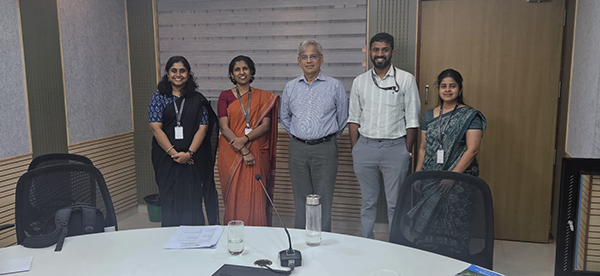
The Department of English organised Global Transdisciplinary Dialogue- 2nd Edition on “Numbers Tell Stories: Data Analytics for the Humanities” on 16th June 2026, in collaboration with Office of Global Networking and Collaborations, as a part of faculty development. The session featured distinguished resource person Dr. Nagaraj Neerchal, Professor, Department of Mathematics and Statistics, University of Maryland, USA, as the distinguished resource person. The programme was designed to enhance the academic and research competencies of faculty members by fostering interdisciplinary dialogue and exposure to global academic perspectives. During the session, Dr. Neerchal shared valuable insights drawn from his expertise in mathematics, statistics, and research methodologies, highlighting the significance of interdisciplinary approaches in contemporary higher education. He emphasised the role of data-driven inquiry, analytical thinking, and collaborative research in addressing complex academic challenges across disciplines. The session also encouraged participants to explore innovative pedagogical practices and research collaborations that transcend traditional disciplinary boundaries.
Global Transdisciplinary Dialogue: Perspectives on Skill Integration in Literature, Media & Learning
Date: 07 April 2026
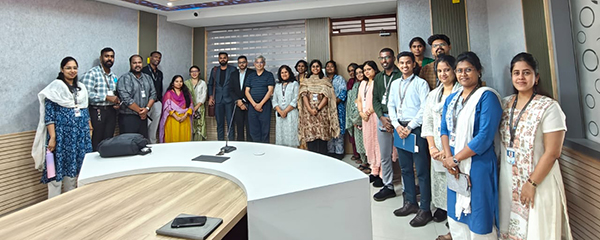
The Department of English organised Global Transdisciplinary Dialogue- 1st Edition on “Perspectives on Skill Integration in Literature, Media & Learning” on 7th April 2026, for the students of I MA English Literature. The session featured distinguished resource persons Prof. Álvaro Barbosa, Vice-Rector, University of Saint Joseph, Macao, and Dr. João Leong Brochado, Head, Department of Media, Arts & Technology, University of Saint Joseph, Macao. The programme aimed to engage students in a transdisciplinary dialogue on the integration of skills across literature, media and contemporary learning practices. Through insightful discussions and presentations, the resource persons explored how literary studies intersect with media technologies, fostering innovative approaches to knowledge production and dissemination. The session provided students with a broader perspective on the evolving nature of humanities education, highlighting the importance of adaptability, creativity, and interdisciplinary engagement. The interaction reflected the active participation and curiosity of the students, who engaged thoughtfully with the ideas presented, making the event a meaningful academic experience.
Scientific Writing: Emerging Career Pathways
Date: 17 February 2026
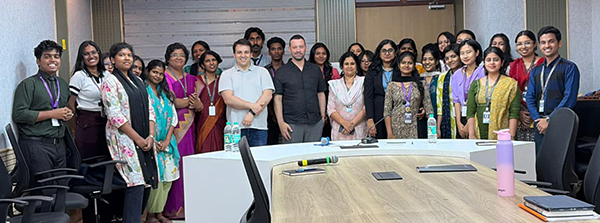
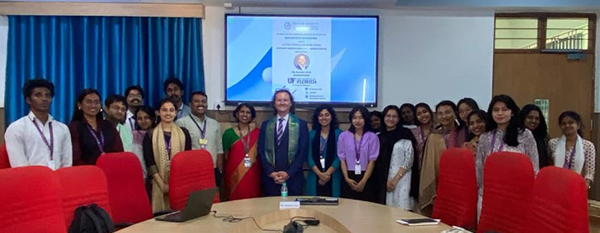
Scientific writing plays a crucial role in bridging language and research, enabling English students to communicate complex ideas with clarity and precision. For MA English Literature students, it offers emerging career opportunities that extend beyond traditional literary fields into research, academia, and knowledge dissemination. Recognising its growing relevance, the Department of English organised an International Lecture Series titled “Scientific Writing: Emerging Career Pathways” for the students of MA English Literature. The session was conducted by Dr. Daniel Czyz, Associate Professor, University of Florida. The lecture began with an introduction to scientific writing, during which Dr. Czyz explained the agenda of the session and the various types of scientific writing. He also discussed how research studies are published, how to search for academic papers, and the effective use of AI tools in research.
Through a vivid PowerPoint presentation, Dr. Czyz elaborated on the concept of scientific writing and illustrated it with relevant examples. The session was informative, interactive, and beneficial for the students.
Infusions of Meaning: Tea as Text
Date: 11 February 2026
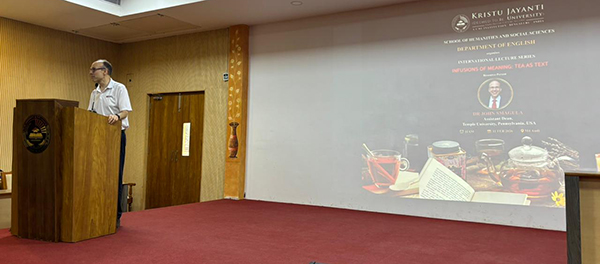
The Department of English organised an International Lecture titled “Infusions of Meaning: Tea as Text,” celebrating the quiet beauty of tea as both experience and symbol. The session was delivered by Dr. John Smagula, Assistant Dean for Graduate and International Programs, Temple University, Philadelphia. The lecture was insightful and thought-provoking, exploring tea as a cultural text infused with history, memory, emotion, and wellness. Drawing connections between tea, coffee, and alcohol, the speaker examined their physical and emotional effects, including stress and calmness. Tea emerged as medicine, comfort, and “emotional time travel,” especially valuable for students navigating academic pressure.
International Lecture on Saying Sorry in Postcolonial Societies
Date: 18 July 2025
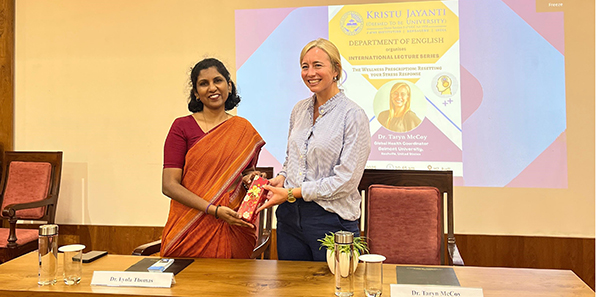
The Department of English, Kristu Jayanti deemed to be University, Bengaluru, organised an enlightening session titled “The Wellness Prescription: Resetting your Stress Response” on 18th July 2025 as part of the International Lecture Series and featured Dr. Taryn McCoy, Global Health Coordinator from Belmont Univsersity, Nashville, United States, as the guest speaker.
Dr. McCoy addressed the growing concerns around stress in modern life and offered practical insights into how individuals can effectively manage and reset their stress responses. Drawing from her experience in global health, she emphasised holistic wellness, the importance of mindfulness and scientifically backed techniques to achieve mental and emotional balance. The session was both informative and interactive, allowing students to engage with relevant health and wellness strategies. Dr. McCoy’s expertise made the talk highly impactful and relevant to the academic community. The event concluded with an engaging Q&A session, leaving attendees with valuable tools for managing stress and promoting personal well-being.
International Lecture on Saying Sorry in Postcolonial Societies
Date: 01 April 2025
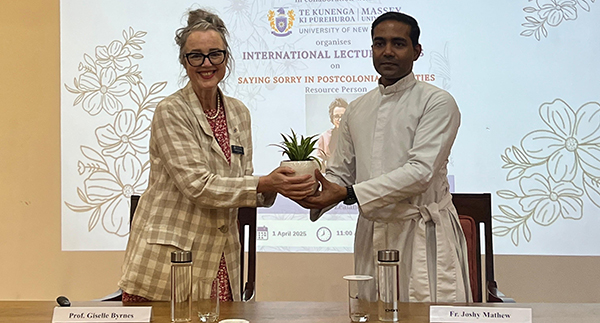
The Department of English, Kristu Jayanti College Autonomous, Bengaluru organised a lecture on “ Saying Sorry in Postcolonial Societies ” as a part of the International Lecture Series on 1st April 2025. The session was led by Prof. Giselle Byrnes, Provost, Massey University, New Zealand. Apologies in postcolonial societies often serve as symbolic gestures of reconciliation but may struggle to address deep-rooted historical injustices. True accountability requires structural change alongside an acknowledgment of past wrongs. Prof Byrnes further discussed the ‘Te Korowai o Wainuiārua Claims Settlement Bill’. This bill would give effect to a deed of settlement signed on 29 July 2023 to settle the claims of Te Korowai o Wainuiārua. The bill includes a historical account of the events and the Crown’s acknowledgements and apology. They also publicly apologized to the Mauri and Chinese people who came to settle in New Zealand. She also discussed how revisiting history through the lens of apology reveals several similarities. The quest for reconciliation highlights the importance of historical truth and evidence, particularly in legal processes. The voice of historical victims takes centre stage, allowing them to speak back to perpetrators and governments. Apologies are offered not only to seek redress but also for the Crown to absolve itself and restore its honour. In the context of official apologies, truth serves as the medium of forgiveness as well as the vehicle through which future redress can be delivered. While we cannot change the past, we can seek to atone for it and learn from it. The lecture concluded with an engaging question-and-answer session.
International Lecture on Exploring Utopian and Dystopian Worlds
Date: 13 March 2025
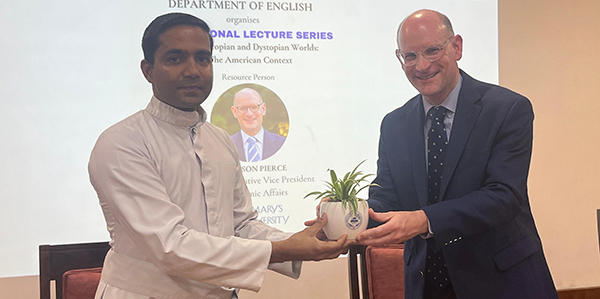
The Department of English, Kristu Jayanti College Autonomous, Bengaluru organised an International Lecture on the topic “Exploring Utopian and Dystopian Worlds: The American Context as part of the International Lecture Series on 13th March 2025. The session was handled by Dr. Jason Pierce, Provost and Executive Vice President of St Mary’s University, Texas, USA. The lecture focused on exploring the Utopian and Dystopian Worlds particularly from the American context. The discussions were about the political phenomenon of Polarization which is very evident in the United States of today. The speaker further explored utopian and dystopian worlds in the American context, examining how they reflect societal ideals, fears, and biases. He further analyzed its impact on culture, politics, and the collective imagination. The lecture also encouraged the students to ponder over some critical questions like “What makes us a human being?” and “What constitutes a good life? The session encouraged the students to critically analyse the concept of Polarization. Further the session focussed on the causes and effects of Polarization on the American society and also about how this phenomenon of Polarization is a problem for the U S polity. There also were discussions on the ways in which the problem could be tackled and a more equitable society could be created. The lecture concluded with an engaging question-and-answer session. Students actively participated, raising questions, sharing insights and seeking clarity on various aspects.
International lecture on Volunteering and Community Outreach
Date: 10 February 2025
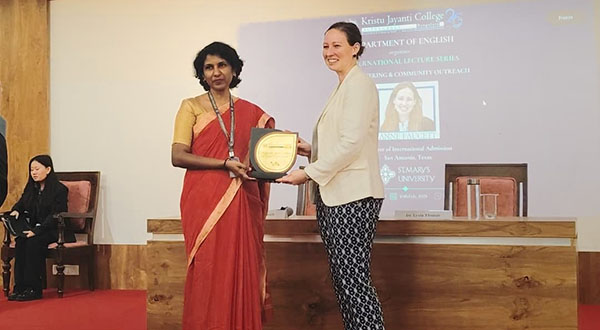
The Department of English, Kristu Jayanti College Autonomous, Bengaluru organised a lecture on “Volunteering and Community Outreach” as a part of the International Lecture Series on 10th February 2025. The session was led by Ms Anne Faucett, Director of International Admission, St. Mary's University, San Antonio, Texas. The lecture focused on volunteering and community outreach and its significance on global education and personal life. Ms Faucett discussed the importance, benefits, and different types of volunteering, as well as specific challenges and solutions. Volunteering and Community Outreach play a vital role in fostering social responsibility and collective well-being. Through active engagement, students can contribute their time and skills to support communities, promote positive change, and build stronger, more inclusive societies. It would also significantly enhance their CV she remarked. She further shared various anecdotes from her own life, to emphasise the joys of volunteering and being part of a community. She talked about her experience as the President of the International Rotary Club and how it has changed her life and altered her perception of people and communities. She talked about the value of volunteering by noting how it helps in creating meaningful bonds with people from across the globe reflecting on how it guides one’s personal growth and widens career opportunities. The session also explored the various skills that can be attained from volunteering, like leadership, teamwork and problem-solving skills. She also shared insights into how volunteering initiates holistic development in people especially students, enhancing their empathy, resilience and social responsibility. The lecture concluded with an engaging question-and-answer session. Students actively participated, raising insights and seeking clarity on various aspects.
The Chancellor Hour: Session with Global Visionary Leaders
Date: 07 February 2025
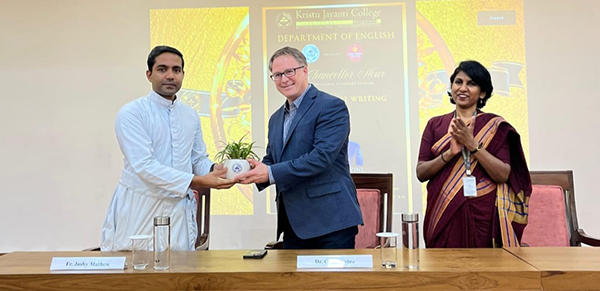
The Department of English, Kristu Jayanti College Autonomous, Bengaluru organised the Chancellor Hour on the 7th of February 2025. The session was led by Dr. Colin Irvine, President, Concordia College, Moorhead, Minnesota, USA. The session was named "Chancellor Hour" as it provided students with a rare opportunity to engage with visionary leaders from around the world and in this case interact with the President of the institution, and learn from his wisdom and experience. The lecture focused on Four-Dimensional writing in creating narratives. The session began with an interesting game of Catch to make the students create a story around it. He introduced space and time into the narratives through a writing exercise which later becomes a story and emphasized how narratives hold time and space. He explained Narrative Theory through the exercise of story creation to make the students aware that this theory studies how people understand and create stories. He also addressed the need of using AI to compliment human capabilities while urging students to approach it with a balanced perspective. The session concluded with his personal story and an engaging question and answer session where the students raised questions regarding the strategies to overcome writer’s block. Students actively participated, raising questions, sharing insights and seeking clarity on various aspects of writing.
Lecture on “Exploring Connections: Social Emotional Learning and Literature”
Date: 29 January 2025
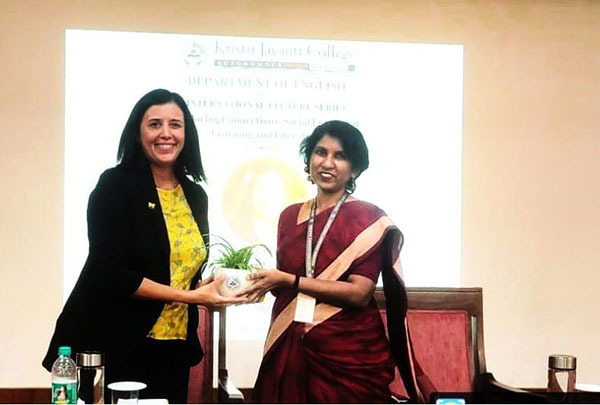
The Department of English, Kristu Jayanti College Autonomous, Bengaluru organised a lecture on “Exploring Connections: Social Emotional Learning and Literature” as part of the International Lecture Series on 29th January 2025. The session was led by Dr. Sapna Thwaite Vice Provost for Academic Affairs & Professor of Education, University of Michigan-Flint, Michigan, USA. Social Emotional Learning (SEL) and literature are deeply interconnected, as literature provides a powerful medium for developing empathy, self-awareness, and emotional intelligence. The lecture focused on the benefits of the Social Emotional Learning (SEL) approach and also major facets of SEL like Identity, Agency and belonging. She talked about the development of empathy, the need for self-awareness and being more reflective. She also spoke about how literature promotes social awareness through different cultures, social groups and diverse viewpoints. Classic and contemporary literary works offer rich narratives that help students recognize and regulate emotions, practice social awareness, and enhance decision-making skills. By analyzing themes of love, loss, resilience, and identity, literature becomes a tool for personal growth, encouraging critical reflection and emotional engagement. Integrating SEL with literary studies cultivates both intellectual and emotional development, preparing individuals for meaningful interactions. She also expressed how literature can be an active tool in relationship skills, social-emotional learning and development. The lecture concluded with an engaging question-and-answer session. Students actively participated, raising questions, sharing insights and seeking clarity on various aspects.
International Lecture on Learning for Life: 5 Big Ideas
Date: 22 January 2025
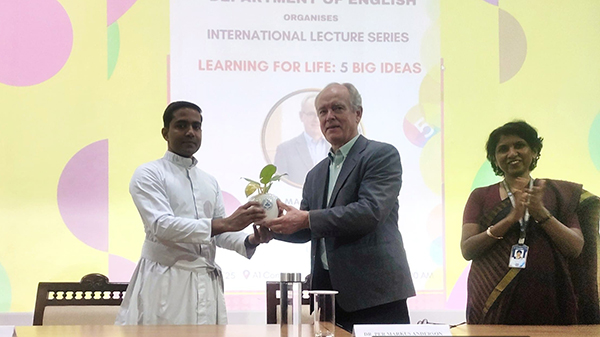
The Department of English, Kristu Jayanti College Autonomous, Bengaluru organised a lecture on “Learning for Life: 5 Big Ideas” as a part of the International Lecture Series on 22nd January 2025. The session was led by Dr. Per Markus Anderson, Professor Emeritus, Concordia College, Moorhead, Minnesota, USA. The lecture focused on five transformative ideas to shape and do life better. Dr Anderson discussed the five ‘R’s’; Resilience, Respect, Responsibility, Response and Resonance which help people navigate their lives with joy. He highlighted the role of colleges in preparing students for the industry and emphasised the need for adaptability. He also addressed the necessity of change in thought patterns to remain relevant in the modern job market. The session also explored the role of artificial intelligence in modern times, with Dr. Anderson envisioning a future where humans coexist with advanced technology. He shared insights on how AI can compensate and complement human capabilities while urging students to approach it with a balanced perspective. He further discussed the ethical dilemmas involved in the use of Artificial Intelligence. The lecture concluded with an engaging question-and-answer session. Students actively participated, raising questions, sharing insights and seeking clarity on various co-related aspects.
The Chancellor Hour: International Lecture on The Impact of AI on Educationg
Date: 16 January 2025
The Department of English, Kristu Jayanti College Autonomous, Bengaluru had organized, The Chancellor Hour – an interaction with global visionary leaders on the topic, “Impact of AI on Education” on the 16th of January 2025. The session was led by Dr. Geoffrey Holmes, Pro-Vice-Chancellor, University of Waikato, New Zealand. The lecture aimed to address the impact of Artificial Intelligence (AI) in transforming education by making learning more personalised, accessible, and efficient. He also elaborated on how AI is shaping futuristic technologies for education and how dependency on these may lead to drastic changes in creative thinking. The resource person further spoke about how as a tool Artificial Intelligence could be used to bring various changes in the field of education and also addressed the need for balancing creative thinking with it. He said by balancing AI with human interaction, education can evolve into a more inclusive and innovative space, fostering global collaboration and lifelong learning. The field of education would definitely benefit from automating administrative tasks and providing data-driven insights to improve instruction. However, challenges like privacy concerns, digital inequality, and potential over-reliance on technology highlight the need for careful implementation he said. The lecture concluded with a question and answer session where the students had the opportunity to seek clarification, share insights and engage in a meaningful dialogue with Dr. Geoffrey Holmes