Faculty Development Programme
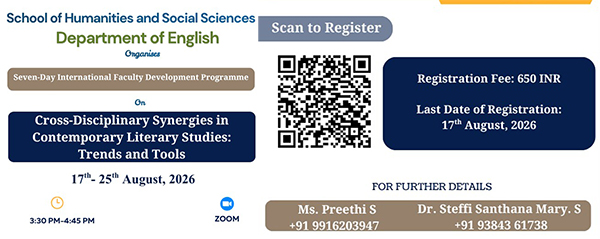
Seven-Day International Faculty Development Programme on “Cross-Disciplinary Synergies in Contemporary Literary Studies: Trends and Tools”
Date:17 to 25 August 2025
The Department of English, School of Humanities and Social Sciences, Kristu Jayanti (Deemed to be University), Bengaluru, organised a Seven-Day International Faculty Development Programme (FDP) on “Cross-Disciplinary Synergies in Contemporary Literary Studies: Trends and Tools” from 17th to 25th August 2026 through Zoom.
The programme aimed to provide faculty members with a platform to engage with emerging developments, interdisciplinary perspectives, innovative research practices, and contemporary pedagogical approaches in literary and cultural studies. It brought together distinguished academics, researchers, and practitioners from India and the United States, facilitating meaningful academic exchange and professional learning.
The FDP featured seven resource persons: Dr Dan Harper, Founder, Interwoven Consulting and International Education Strategist, Memphis, Tennessee, USA; Dr Sarika Gupta, Associate Dean, School of Social Sciences & Languages, VIT, Vellore; Dr V. K. Karthika, Assistant Professor, NIT Trichy; Dr Abubakkar Sthiqque, Assistant Professor-I, SASTRA University, Thanjavur, and Founder, Edusquad Literary Club; Dr Nandini Ghosh, Assistant Professor of Sociology, Institute of Development Studies, Kolkata; Dr T Ravichandran, Professor, Department of Humanities and Social Sciences, IIT Kanpur; and Dr J. S. Anantha Krishnan, Researcher, Poet, Critic and Academic.
The diverse academic expertise of the resource persons enriched the programme and encouraged participants to explore literature in relation to technology, posthumanism, language pedagogy, visual research, gender, disability, care, and emerging research methodologies. The FDP provided a stimulating platform for interdisciplinary dialogue, knowledge sharing, critical engagement, and professional development, enabling participants to broaden their academic perspectives and engage with evolving trends and tools in contemporary literary studies.
LMS Orientation for New Faculty
Date:11 July 2025
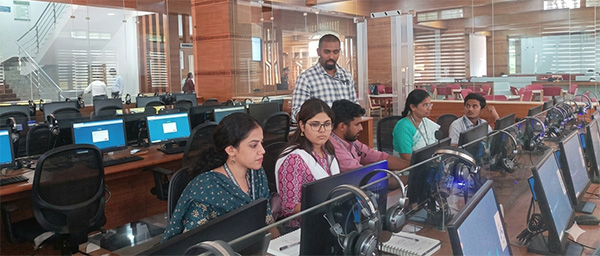
The Department of English conducted an LMS orientation session for newly appointed faculty members on 11 July 2025 at 3:45 PM in the Language Lab, Humanities Block. Organized by the department’s LMS Committee, the session aimed to familiarize new faculty with the Kristu Jayanti Learning Management System (KJLMS) to facilitate a seamless integration into the department's digital teaching practices. Five newly joined faculty members attended the session, which covered essential aspects of the LMS, including course enrollment procedures, uploading course materials, managing assignments, and using key plugins to enhance student engagement and assessment. The orientation also addressed frequently used features such as discussion forums, gradebooks, and attendance tools. The session provided a strong foundation for effectively navigating the LMS and highlighted its role in supporting blended and online learning. By the end of the orientation, the faculty members were equipped with the necessary skills to independently manage their courses on the platform, thereby ensuring consistency and quality in the department's digital learning initiatives.
Faculty Enrichment Programme on Professional Ethics & Academic Integrity
Date:04 July 2025
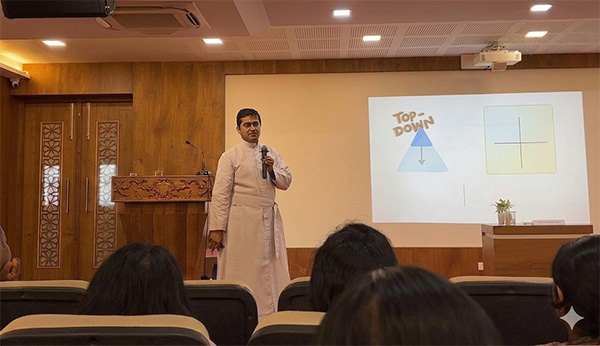
The Department of English at Kristu Jayanti College (Autonomous), Bengaluru, organized a Faculty Enrichment Programme on “Professional Ethics and Academic Integrity” on July 4, 2025, at the H2 Auditorium in the Humanities Block. The session was attended by faculty members of the department and aimed to promote ethical awareness and strengthen a culture of integrity in academic practice. The resource person for the programme was Fr. Jais V Thomas, Financial Administrator and Director of Jayantian Extension Services. Through a reflective and engaging presentation, Fr. Jais explored the deeper dimensions of ethics in professional and academic life.He began by introducing the concept of the Power of Mattering, emphasizing the fundamental human need to feel seen, valued, and significant. This sense of mattering, he explained, is central to creating ethical and productive work environments. He then discussed the idea of Psychological Safety, clarifying that it does not imply comfort or ease but rather the ability to speak up, take risks, and participate without fear of negative consequences. He stressed that psychological safety must be paired with accountability and that cultivating this balance requires intentional leadership.Fr. Jais also addressed how institutions can provide varying levels of safety depending on individuals’ roles and experiences, encouraging inclusive spaces where individuals feel respected, supported in their learning, confident to contribute, and empowered to question and innovate. By linking these insights to the broader context of academic integrity, the session offered a meaningful reflection on the responsibilities of educators. The programme was well-received and left participants with a renewed understanding of ethical academic engagement.
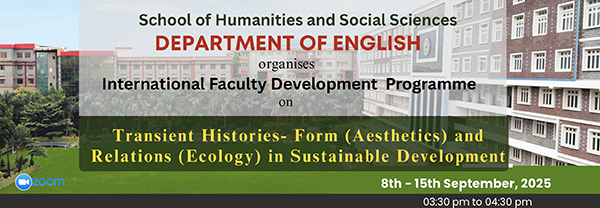
FDP on “Transient Histories - Form (Aesthetics) and Relations (Ecology) in Sustainable Development.”
Date:08 to 15 September 2025
The Department of English, Kristu Jayanti Deemed to be University, organized an International Faculty Development Programme from 8th to 15th September 2025 on the theme “Transient Histories – Form (Aesthetics) and Relations (Ecology) in Sustainable Development.” The sessions featured eminent scholars addressing ecological and cultural dimensions of sustainability. Prof. Mohan J. Dutta (Massey University, New Zealand) explored communication, culture, and planetary justice in the context of sustainable transitions, while Prof. Janet Stephenson (University of Otago, New Zealand) shared insights on sustainability practices and cultural responses. Dr. Avishek Parui (IIT Madras) examined memory, narrative, and environmental imaginaries, and Prof. Murali Sivaramakrishnan (Pondicherry University) discussed art, literature, and ecocritical perspectives. Dr. Rayson K. Alex (BITS Pilani, Goa) highlighted Indigenous ecological knowledge and eco-narratives, followed by Dr. Swarnalatha R (IIT Madras), who reflected on digital ecologies and contemporary climate discourses. The programme concluded with Dr. Anchitha Krishna (NIT Calicut) focusing on environmental humanities and pedagogical approaches. Each session offered fresh perspectives that blended aesthetics and ecology, fostering rich interdisciplinary dialogue. The FDP provided faculty and researchers with valuable insights, collaborative opportunities, and renewed academic energy to address sustainability challenges.