Beyond Exchange Rates: The Story of India's Declining Rupee
 |
Meenakshi P 25IBFA29 First Year –II BCom, IBF ‘A’ |
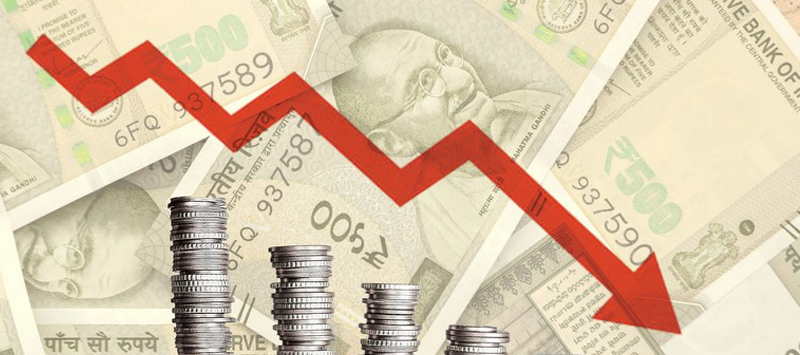
Money is something we use every day. Whether it's purchasing or selling products, money has become an indispensable part of our existence. It may look as simple as exchanging money for goods, but behind each currency is a whole different world of politics, economics and global trade.Over the past few months, with Donald Trump elected as the President of the United States and imposing trade tariffs, the relationship between the Rupee and the Dollar has been one of the most worrisome topics among citizens, politicians, and businessmen. Over the years, the value of the rupee has weakened against the dollar, raising concerns among policymakers, businesses, and ordinary citizens alike. Understanding why this happens, what factors influence the rupee’s decline, and how the government responds is essential in today’s world.
Back in 1947, after India gained independence, the value of the rupee stayed more or less stable as the economy was strictly controlled by the newly formed Indian Government. Around ₹3.30 rupees equated to one dollar (RBI - 2023). But incidents post-independence, like wars, famines, droughts and other crises, caused the rupee to fluctuate. One of the main factors was that India was importing more than it exported (World Bank, 2023). This caused the rupee to move freely in the market, and the government did not have the strong hold on it as it did previously. Foreign exchange reserves decrease at an alarming rate, and India no longer has enough to pay for their imports. After a major economic crisis in 1991 (RBI-2023), the Indian rupee steadily weakened against the US dollar, falling from ₹25 per dollar to ₹60 per dollar in the 2010s to ₹80 in the 2020s (Data from RBI)The US dollar is considered the world’s primary reserve currency (US Department of the Treasury, IMF). Meaning most countries carry out trade, exports and imports in dollars rather than their own currencies for simplicity’s sake. It is considered by investors and politicians to generally be safer and more stable than most other currencies in times of global economic problems (U.S. Department of the Treasury- 2021). This is why imports, exports, businesses, and many other things use US dollars as their main currency of exchange. As a result, there is a high demand for US dollars.
Now, India imports many things from other countries like oil, electronics, machinery, petroleum etc. As mentioned before, these purchases take place in dollars. Here comes the problem where India requires more dollars than it earns. To obtain more dollars, India has to exchange an even larger sum of rupees, effectively weakening the rupee. Tariffs are taxes that are imposed on imported goods (Reuters- 2023). The Trump Tariffs, aimed at protecting US companies, impose a higher rate of tariffs on imported goods like from China and India thereby making these products more expensive within the US, urging their citizens to buy US-produced goods.
Since the tariffs make Indian goods more expensive within the US, more Americans avoid purchasing imported goods. This results in India earning lesser dollars and whatever dollars it does have will be used elsewhere. And since India still needs dollars to buy oil, electronics etc from other countries, it has to exchange more rupees for dollars. This is one of the main reasons for the weakening of the rupee. It is predicted that the rupee will fall to ₹92 per US dollar by the end of March 2026.So what does this mean for India? For citizens, it means a higher cost of living, higher fuel prices, imported items, and foreign travel. For businesses, it means exporters earn lesser profits, fewer international companies invest in Indian companies and higher costs of materials. It’s creates immense economic pressure on the country as a whole.
While they cannot entirely stop the fall of the rupee, the RBI and government have taken certain measures to slow down the fall of the rupee. The RBI sells dollars from its foreign exchange reserves in exchange for rupees. It also increases interest rates, as higher interest rates make investing in India a more attractive prospect for investors. The Government also works on regulating inflation because if prices rise rapidly, it works against their interests. The government also pushes its citizens to buy goods made in India to make the country less dependent on imports.
In conclusion, the fall of the rupee isn’t predetermined by any single factor but by multiple factors working against it. Tariffs, reliance on imports and other such reasons make India’s currency weaker. While the RBI and government cannot eliminate the fall and weakening of the rupee, they are making efforts to slow it down. In the long run, strengthening exports, reducing import dependence and managing inflation are essential for supporting the rupee and ensuring economic balance. As citizens, it is our duty to work towards supporting the stability of our currency.