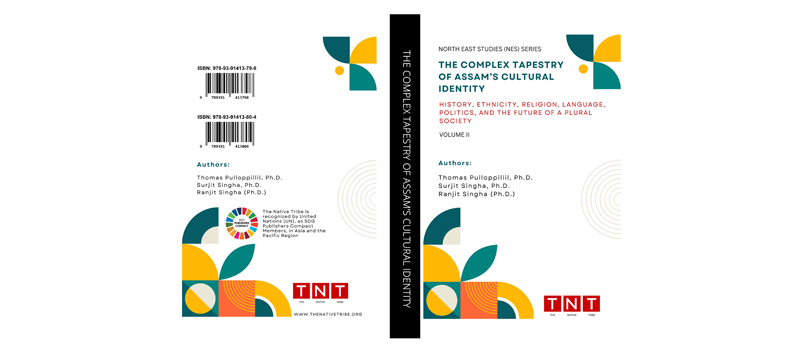
The Complex Tapestry of Assam's Cultural Identity: History, Ethnicity, Religion, Language, Politics, and the Future of a Plural Society
 |
Dr. Surjit Singha, Associate Professor, Ph.D. Research Guide & Research Faculty, Department of Commerce, School of Commerce, Accounting and Finance, Kristu Jayanti (Deemed to be University), Bengaluru, India |
The book is co-authored by Thomas Pulloppillil, Ph.D., Bishop of Bongaigaon; Dr. Surjit Singha, Ph.D., Associate Professor; and Ranjit Singha, (Ph.D.), Ph.D. Research Fellow at Christ University. Together, we set out to do something that, looking back, we probably underestimated. We wanted to explain, in one volume, what it means to belong to Assam — not administratively, not politically, but culturally, in the layered way a place accumulates meaning over a thousand years.
The theme we settled on — a tapestry — wasn't a metaphor we reached for lightly. We chose it because it was the only honest word for what we found: not one story, but many strands — historical, ethnic, religious, linguistic, political — woven together, and still visible as separate threads if you look closely enough.
Where a Culture Actually Begins
We knew we had to begin with geography, before we ever touched a king or a census record. Before there were kingdoms or communities, there was the Brahmaputra. We wanted the book to make clear, from its very first pages, that culture doesn't emerge from ideas alone — it emerges from land, from what a river lets its people do and where it lets them live. So, we spent real time on the floodplains, the biodiversity, the settlement patterns that followed the water, before allowing ourselves to move into history proper.
Tracing the Deep Past
From there we traced Assam's deep past — the ancient kingdom of Kamarupa, the Kamatapur, the dynasties that rose and fell, the trade routes that connected Assam not just to the rest of the subcontinent but to Tibet, Bhutan, and Southeast Asia. One thing we insisted on throughout the writing was discipline about evidence — resisting the temptation to let ancient Assam slide into myth dressed up as history. Where the record is genuinely uncertain, we said so.
We carried the narrative through the medieval regional kingdoms — the Kachari, the Koch, the Dimasa, the Ahoms and there regional small kingdoms — and then into colonial Assam: the tea industry, the railways, the missionary schools, the slow and uneven transformation into the Assam that would eventually enter modern India.
That is the first half of the book. The second half is the part closest to my heart.
Choosing Depth Over Breadth
Rather than surveying every ethnic community in Assam at equal, shallow depth, we made a deliberate choice to go deep rather than wide. After a broad chapter laying out ethnic diversity as a concept, we devoted nearly the entire second part of the book to a sustained, close study of one community: the Koch Rajbongshi.
We did not want to treat this lightly. We wanted to sit with their contested origins — historical, anthropological, and linguistic perspectives, side by side, without pretending the debate is settled. We wanted to tell the story of Thakur Panchanan Barma and the Kshatriya movement, the community's long push for recognition through the colonial census records of the 1870s and 1880s. We wanted to honor their indigenous religious life — the Phoni Monasha tradition (animism) — their language, festivals, food, and weaving, in the kind of depth that a single paragraph in a broader survey could never give them.
Our reasoning was this: you cannot understand a plural society by skimming its parts. You have to go deep somewhere to understand what identity actually costs a community — in negotiation, in memory, in bureaucratic recognition — and only then can you begin to imagine what that same struggle might look like elsewhere across the tapestry.
Writing an Honest Book, Not a Final One
There's one more thing we want to mention, because it mattered a great deal to all three of us. Before our conclusion, we chose to include a section titled, quite plainly, "Limitations of the Study." We wanted to say clearly that we could not treat every community with the depth we gave the Koch Rajbongshi, that some questions about ancient Assam remain genuinely unsettled among historians, and that any account of a living, changing culture is only ever a snapshot — one that will need revisiting as Assam itself continues to change.
In a field where identity and history are so often written with untrue certainty — and where, in a region like Assam, that certainty can carry real political weight — we wanted this book to resist that temptation. We did not want to write the last word. We wanted to write an honest one.
We also want to be direct about something else: this book was never meant to promote any one ethnic, linguistic, religious, or political viewpoint. Given how questions of identity, migration, and citizenship remain live in Assam today, that was not a small commitment to make, and it shaped every chapter we wrote.
What "Plural" Actually Means Here
When we talk about Assam's plural identity, we don't mean a fixed thing. We mean a living tapestry of many communities, languages, religions, and histories, interacting and evolving together over centuries — identity as an ongoing process of coexistence, not a settled or singular tradition.
And that's really what the tapestry metaphor is doing. A tapestry is a woven fabric made of many different colored threads. Assam's identity, as we came to understand it, is made up of many distinct strands — ethnic, religious, linguistic, historical — woven together into one whole, where each thread stays visible even as it becomes part of a larger picture.
A Question for the Reader
So, the question we want to leave with you today is the same one that stayed with us throughout the writing of this book: can a plural identity ever truly be captured on the page — or can a book only ever point toward it, the way we hope this one does, and trust its readers to carry the rest?
Reference:
Pulloppillil, T., Singha, S., & Singha, R. (2026). The complex tapestry of Assam's cultural identity: History, ethnicity, religion, language, politics, and the future of a plural society (Vol. 2). The Native Tribe. https://www.thenativetribe.org/book/nes/nes-v2