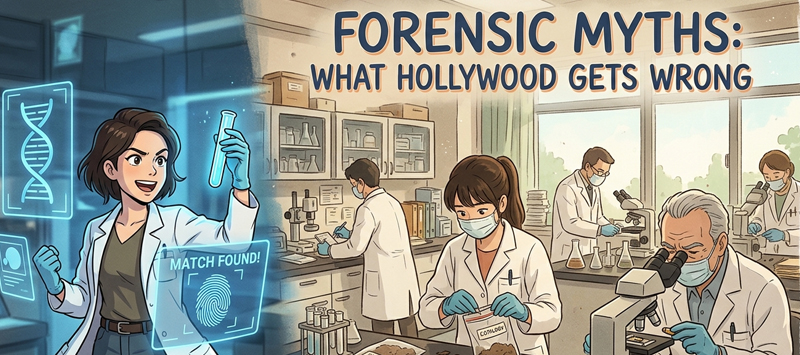
Forensic Science Myths from Movies: What Hollywood Gets Wrong
 |
Yashaswini M, 25FCBB61, BSc III Semester, Department of Forensic Science, Kristu Jayanti (Deemed to be University), Bengaluru, India |
Have you ever watched a crime movie where a murder is solved in less than an hour? A fingerprint is discovered almost instantly, DNA results appear within minutes, and one forensic expert seems to handle everything—from collecting evidence at the crime scene to identifying the suspect and helping make the arrest.
It makes for great television. But is that how forensic science really works? The answer is not quite.
Movies and television show often dramatize forensic investigations to make stories faster, more exciting, and more suspenseful. While these portrayals have made forensic science popular, they have also created several misconceptions about what forensic professionals actually do.
Let's separate Hollywood fiction from forensic reality.
Myth 1: DNA Results Are Instant
The Hollywood version:
A biological sample is collected at the crime scene, taken to a laboratory, and a DNA profile appears on the computer within minutes.
The reality:
DNA analysis involves multiple scientific stages. Evidence must be properly collected, packaged, documented, and transported. In the laboratory, DNA may need to be extracted, quantified, amplified, analysed, and interpreted before a conclusion can be reached.
The time required can vary considerably depending on the type and condition of the sample, the laboratory's procedures and workload, the complexity of the examination, and the urgency of the case.
DNA is a powerful forensic tool—but it is not a magic button that instantly identifies a person.
Myth 2: Every Object Has a Perfect Fingerprint
The Hollywood version:
An investigator touches an object, applies a powder, and immediately discovers a complete fingerprint.
The reality:
Fingerprints are not guaranteed to be present or recoverable. They may be partial, distorted, smudged, contaminated, or affected by the characteristics of the surface and environmental conditions.
Even when a latent fingerprint is recovered, examination and comparison require careful scientific assessment. A usable fingerprint is evidence that must be interpreted—not simply a perfect image waiting to reveal a suspect.
Myth 3: One Forensic Expert Does Everything
The Hollywood version:
One brilliant forensic scientist collects evidence at the scene, performs laboratory tests, analyses digital evidence, interviews suspects, and eventually solves the entire case.
The reality:
Real investigations usually involve multiple professionals with different areas of expertise.
Depending on the case, these may include:
• Crime scene investigators
• Forensic biologists and DNA analysts
• Forensic chemists and toxicologists
• Fingerprint examiners
• Digital forensic specialists
• Medical professionals and forensic pathologists
• Investigating police officers
• Other specialised forensic professionals
Each contributes specific knowledge to the investigation. Forensic science is therefore largely a team effort, rather than the work of a single super-detective.
Myth 4: Every Crime Scene Contains Perfect Evidence
The Hollywood version:
Every crime scene contains a clear fingerprint, a complete DNA sample, a weapon, and several other pieces of decisive evidence.
The reality:
Real crime scenes can be unpredictable.
Evidence may be:
• Missing
• Degraded
• Contaminated
• Damaged
Incomplete
• Difficult to locate or recover
Sometimes there may be very little physical or digital evidence available.
Investigators may therefore need to combine forensic findings with other sources of information, such as witness accounts, CCTV footage, documentary evidence, digital records, and investigative intelligence.
Forensic science does not always provide a single dramatic answer. Sometimes its greatest contribution is helping investigators exclude possibilities, test hypotheses, or establish what the evidence does not support.
Myth 5: Technology Can Identify Anyone Instantly
The Hollywood version:
A forensic expert enters a fingerprint, photograph, or DNA profile into a computer, and the suspect's name appears seconds later.
The reality:
Forensic databases and automated comparison systems can be extremely useful, but they do not guarantee an instant identification. A database comparison generally depends on the quality of the submitted evidence and the records available in the relevant database. If there is no corresponding record, a search may not produce a match.
Technology assists forensic professionals; it does not replace scientific interpretation.
The “CSI Effect” (Crime Scene Investigation)
The popularity of crime dramas has also generated discussion about what is often called the “CSI Effect.”
The term generally refers to the possibility that fictional portrayals of forensic science may influence people's expectations about real criminal investigations and forensic evidence.
For example, viewers may come to expect:
• Every crime to produce DNA or fingerprint evidence.
• Laboratory results to be available almost immediately.
• Technology to identify suspects with certainty.
• Forensic evidence to provide a definitive answer in every case.
Real forensic investigations are considerably more complex. The strength and significance of evidence depend on how it was collected, preserved, examined, interpreted, and presented.
The Real Science Behind Forensic Science
The reality of forensic science may not be as fast-paced as Hollywood suggests, but it is far more scientifically fascinating.
Behind every forensic conclusion is a process involving observation, scientific methodology, quality control, documentation, interpretation, and professional judgement.
Forensic professionals must work carefully because even a small error in collection, preservation, analysis, or interpretation can affect the reliability of evidence.
This is why patience, precision, objectivity, ethics, and teamwork are fundamental to forensic practice.
Final Thoughts
Hollywood has undoubtedly helped make forensic science popular. However, the forensic laboratory is not a place where mysteries are solved by dramatic shortcuts and instant computer results.
Real forensic science is built on science, evidence, critical thinking, careful procedures, and collaboration.
The next time you watch a crime show and see a DNA result appear in seconds or a fingerprint identify a suspect instantly, remember: that may be great television, but forensic reality is much more methodical.
And perhaps that is what makes real forensic science even more fascinating—the truth is not created for dramatic effect. It has to be carefully discovered, scientifically tested, and responsibly interpreted.