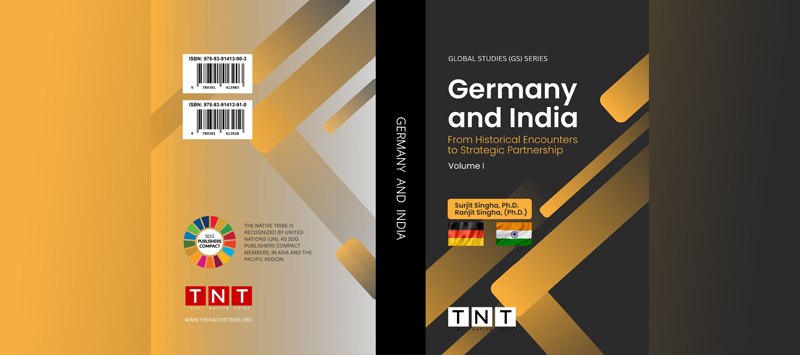
Germany and India: From Historical Encounters to Strategic Partnership
 |
Dr. Surjit Singha, Associate Professor, Ph.D. Research Guide & Research Faculty, Department of Commerce, School of Commerce, Accounting and Finance, Kristu Jayanti (Deemed to be University), Bengaluru, India |
Let me start with a question: when did India and Germany actually become "partners"?
Most people would say 1951 — the year our two countries formally exchanged diplomats. But that answer is wrong. Or rather, it's only half right.
The real story starts almost a century and a half earlier — in the private libraries of German scholars who had never set foot in India, poring over Sanskrit texts, utterly convinced that this ancient language held the key to understanding language itself. Before India and Germany ever exchanged an ambassador, they exchanged something rarer: ideas.
That's the story I want to tell you today — how a relationship between two nations moved from libraries, to battlefields, to boardrooms, to laboratories — and how it arrives, in 2026, at its 75th anniversary as one of the most significant strategic partnerships either country has.
What the Book Is
Germany and India: From Historical Encounters to Strategic Partnership is a 500-plus-page journey across six parts and fifteen chapters. It moves chronologically:
• From 19th-century German scholars falling in love with Sanskrit,
• Through the tangled, complicated politics of the colonial era and two World Wars,
• To India's careful, principled choice in 1951 to recognize a new, democratic West Germany — not the Germany of the war,
• Through the early diplomatic years that quietly built institutions like IIT Madras,
• Into the economic and industrial partnership of today — automobiles, chemicals, semiconductors —
• And finally, to the strategic partnership of the 21st century: the Indo-Pacific, artificial intelligence, green hydrogen, and the 75th anniversary in 2026.
It's history, but it's also very much a book about now — about why this relationship matters more today than at any point in its past.
A Closer Look — Two Stories Worth Reading Aloud
Here are two moments from the book I'd like to share with you directly.
1. Ideas before embassies
Long before diplomats, it was philosophers who connected India and Germany. Arthur Schopenhauer discovered the Upanishads through translation and treated Indian philosophy not as an exotic curiosity, but as a serious intellectual challenge to European thought. Sanskrit itself, once compared systematically to Greek and Latin, helped invent an entire academic discipline — comparative linguistics. India shaped how Europe thought about language, religion, and civilization, a full century before either country had an embassy in the other.
2. A university built on trust
In 1956, a landmark visit to West Germany rebuilding itself out of the ashes of the war set something in motion. Out of that visit came something concrete and lasting: IIT Madras, founded through Indo-German cooperation — German professors, German equipment, and crucially, Indian faculty trained in Germany so the institution could stand on its own. That last detail matters. This wasn't simply "technology transfer" — it was capacity-building, on purpose, so that dependency would end and partnership could begin. IIT Madras is still, today, one of India's premier institutions. That's the kind of legacy that outlives any single political leader.
Why This Matters Today
The book doesn't end in the past. It closes on 2026 — the 75th anniversary of Indo-German diplomatic relations, marked by high-level visits between the two governments and new agreements on semiconductors, critical minerals, and green hydrogen. Bilateral trade hit a record $35.4 billion in 2025. Germany has more than 2,000 companies operating in India; nearly 60,000 Indian students are studying in Germany right now.
What began as two scholars translating Sanskrit grammar has become a relationship spanning defence cooperation, the Indo-Pacific, artificial intelligence, and climate policy. That arc — from ideas, to war, to diplomacy, to industry, to strategy — is the whole argument of the book in one sentence.
If there's one thing I hope you take from this book, it's this: relationships between nations, like relationships between people, are rarely built in a single moment. They're built in layers — a scholar's curiosity, a wartime compromise, a diplomatic handshake, a classroom in Chennai built with German equipment. Seventy-five years of Indo-German partnership didn't start with a treaty. It started with someone, somewhere, deciding that another civilization was worth understanding.
Reference:
Singha, S., & Singha, R. (2026). Germany and India: From Historical Encounters to Strategic Partnership (Vol. 1). The Native Tribe. https://www.thenativetribe.org/book/gs/gs-v1